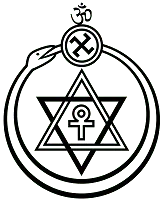

“To study a symbol is to move through form toward the purpose that created it.”
Esoteric study of symbols is not about interpreting shapes or seeking fixed meanings. It is, above all, a training of consciousness — a practice that strengthens the bridge between the concrete mind, emotional sensitivity, and spiritual intuition.
This article does not aim to explain the meanings of specific symbols such as the cross, the wheel, or the circle. Our goal is prior to that: to understand why and how to study symbols from a modern theosophical perspective, especially in light of the teachings of Alice Bailey and Master Djwal Khul.
In esoteric terms, every symbol is a gateway to a deeper subjective purpose. It expresses, in visible form, a hidden idea — and behind that, a spiritual impulse.
Studying symbols in this way is an initiatory practice. It prepares the mind, sharpens inner observation, and awakens the intuitive faculty — one of the main goals on the conscious spiritual path.
Why Study Symbols?
A symbol, in esoteric language, is a bridge between soul and form. To understand its codes is, therefore, to uncover deep aspects of one’s own consciousness.
Theosophy regards symbolic study not merely as an interpretive technique, but as an exercise in integrating the subtle bodies. It develops attention, sensitivity, the mind — and above all, the intuitive channel.
According to Djwal Khul:
“Symbols are the outward and visible forms of the inner spiritual realities.”
— Djwal Khul, Glamour: A World Problem
This definition is broad and profound. Every form, on any plane of existence, is an external expression of an inner reality. The sun, the elements, the human body, words, rituals, gestures — all are symbols, as they manifest subjective purposes and qualities.
Studying a symbol is a way of approaching the reality it veils. It is the bridge between the visible and the invisible, between form and idea, between purpose and its expression.
In Theosophy, we learn that symbols do not arise by chance. They are created and used by conscious beings at various levels of evolution. The Solar Logos — the divine being animating the solar system — expresses its purpose through the Seven Rays. The symbols associated with these Rays are reflections of the maturity of those spiritual energies. The Planetary Logos, in turn, interprets and expresses that purpose in the specific context of Earth’s evolution.
Humanity, as a co-creator, also plays a role: the symbols we generate reflect our level of consciousness and our understanding of spiritual intention.
Thus, the exoteric form of a symbol is not fixed — it evolves with its creators. Studying symbols is also a study of the consciousness that created them, and an attempt to align ourselves with their originating purpose.
A Path in Four Stages
Studying a symbol deeply is more than an intellectual exercise — it is an initiatory process that demands refined attention, quiet persistence, and ongoing self-observation.
Each symbol acts as a resonance field that moves different layers of consciousness. Over time, this contact causes real inner transformation, reshaping not only ideas, but also emotions, energetic patterns, and modes of perception.
The method we present here is organized into four progressive stages, mirroring the movement of symbolic energy through the vehicles of the personality:
- Exoteric study
- Astral identification
- Mental synthesis
- Conscious application
These stages are not rigid compartments, but phases in a dynamic cycle. They reflect the path by which a symbolic form is internalized, eventually becoming a living expression of the soul in the world.
Each stage deepens the previous one, expanding perception and preparing the student for subtler and more transformative insights.
Stage 1 — Exoteric Study
The first approach to a symbol should be analytical and objective. This involves studying its outer structure, cultural context, numerical and geometrical attributes, and associated imagery. Here, we use all the content the concrete mind has accumulated: readings, ideas, comparisons.
This corresponds to what Djwal Khul calls exoteric study — knowledge at the level of form. The questions might include:
- What elements make up this symbol?
- Which traditions use it?
- What meanings are commonly attributed to it?
- How does it relate to known esoteric teachings?
This analysis is not superficial. It lays the stable foundation for deeper layers of understanding to unfold.
However, exoteric knowledge alone satisfies only the personality. It is necessary, but not sufficient. The true path of symbolic understanding begins when we go beyond form — and come into contact with the subjective vibration the symbol expresses.
Stage 2 — Astral Identification
Once the intellectual analysis is complete, a more subtle process begins: observing the energetic effect of the symbol on ourselves.
By contemplating the symbol regularly, the student may begin to notice:
- What emotions does it evoke?
- What aspirations or resistances emerge?
- What type of energy seems to radiate from it?
This is no longer form study, but a practice of conscious vibrational observation. The symbol acts as an internal resonance field, awakening reactions that vary depending on the state of the personality.
Djwal Khul suggests studying only four symbols per year — a pacing that reflects the transformative nature of this process. The slow rhythm isn’t due to analytical complexity, but because vibrational identification demands continuous observation, internal honesty, and daily discipline.
While intuition belongs to the buddhic plane, its stimulation begins in the refined astral body. A purified astral nature functions as a bridge between personality and soul, making it a receptive channel for the subtle impressions of the Spiritual Triad.
The aim of this stage is not to understand, but to feel with lucidity. To feel the symbol acting upon our subtle bodies, awakening qualities, tensions, or aspirations.
These reactions are not predictable or generalizable. Therefore, the symbolic study is inherently individual — each student must acquire their own perception through direct experience, not secondhand explanations. This demands persistence, delicate observation, and patience.
Over time, consistent contact with the symbol — with honesty and inner listening — refines our sensitivity. And that refinement gradually awakens the intuitive faculty, which we will explore in the next stage.
Stage 3 — Mental Synthesis
After observing emotional responses to the symbol, it is time to return to the mind — now in a more refined and receptive state.
Here we seek to formulate the essential concept that the symbol expresses. This is not fragmented analysis, but a leap toward abstract synthesis — an attempt to grasp the unifying principle behind the form.
Guiding questions might include:
- What idea does the symbol convey as a whole?
- What principle does it embody?
- Can it be summarized in a word, a phrase, an inner image?
This stage is akin to meditative work. The mind becomes a silent mirror, seeking to reflect the subtle intention that gave rise to the form.
The process is complete when all perceived meanings — intellectual and experiential — converge into a single central concept, a synthetic formulation. Until that integrative insight arises, the mind remains unsettled.
Yet this concept is not the ultimate purpose.
To illustrate, imagine a company suffering from inefficiency. Upon investigation, the root problem is found to be poor communication between departments. The emerging concept is “interdepartmental communication” — but the underlying purpose is greater: coordinating collective effort to enable growth.
To fulfill this, the company creates concrete tools — meeting rooms, new roles, communication systems — each representing part of the solution. Alone, they carry varied meanings. Together, they serve a unifying purpose that transcends them.
Spiritual symbols operate similarly. They carry ideas, but their full study is only complete when we sense the motivating purpose that binds and gives meaning to all their aspects.
This realization sets the stage for the final step.
Stage 4 — Conscious Application
The study does not end with conceptual understanding — it fulfills itself when it generates transformation.
In this stage, the symbol becomes a practical tool. It can be:
- Invoked during meditation to awaken a specific quality;
- Used in visualization practices as a means of internal alignment;
- Recalled in daily life as a reference to a spiritual truth;
- Integrated into action as a living expression of a higher ideal.
Even more, the practitioner begins to recognize symbols in life itself: events, encounters, cycles, dreams — everything can become a mirror of inner patterns. Life becomes a symbolic language, and the seeker a sensitive reader of the soul’s many expressions.
By integrating the symbol into direct experience, the cycle completes: from form, to emotion, to idea, to action. The soul finds a channel, and the personality becomes a conscious instrument of expression.
The symbol, at last, is no longer merely studied — it is lived.
Conclusion
When studied in this living way, the symbol is not just a source of meaning — it becomes a bridge between the personality and the soul.
It is an exercise in refined attention, vibrational sensitivity, mental synthesis, and practical integration. It strengthens the antahkarana, develops abstract thinking, and awakens intuition — essential faculties on the path of discipleship.
Beyond that, symbolic work trains the consciousness in subtle perception and prepares it to build the antahkarana — the luminous bridge linking the concrete mind, the soul, and the higher planes.
As we grow more aware of the symbols within and around us, we begin to live with greater purpose, alignment, and clarity. The symbol reveals us — and reorganizes us.
“To penetrate form, find the subjective reality, and apply it with wisdom — this is the true path of the symbol.”
The true value of a symbol is revealed through practice. Choose one that resonates with you and experiment patiently. What does it awaken in you? How does it evolve over time? That is the beginning of a study that is, at heart, a journey inward.
Support the Project
This site is independently maintained, with no institutional ties. If the content inspires you, consider supporting it through a small donation.