“Before a man can tread the Path, he must become the Path itself.”
— Djwhal Khul, The Rays and the Initiations
Antahkarana is a Sanskrit word meaning “the inner cause.” In the esoteric context, it refers to the bridge that connects the lower concrete mind to the soul and, through it, to the Monad — the divine spark within each human being. It is a vibrational channel that unites the lower and higher aspects of consciousness, gradually developed along the path of spiritual evolution.
According to the teachings of Theosophy, especially in the works of Alice Bailey, the antahkarana is composed of three main threads, which interweave and sustain this connection:
The Three Threads of the Antahkarana
- The Sutratma – the Thread of Life
Also known as the “silver cord,” this is the thread that links the Monad to the personality, passing through the soul. It is anchored in the physical heart and represents the life impulse that maintains incarnation. Its flow is descending — “from above downward” — and does not depend on the conscious human will, as it reflects the vital flow of the Monad. - The Thread of Consciousness – the Thread of Intelligence
Known as the “golden cord,” it connects the soul to the physical brain via the lower mind. It is anchored in the head and serves as the channel of self-awareness and perception. It is through this thread that our consciousness “travels” during sleep, and its development depends on human evolutionary effort — it is built “from below upward.” - The Thread of Creativity – the Current of Activity
This energy line is anchored in the throat and expresses the human being’s creative capacity on the mental plane. Its development is related to the conscious use of the mind in creating forms, ideas, and constructive structures in the world.
Together, these three threads form the channels through which life, consciousness, and spiritual activity flow between the higher planes and the incarnated personality.
The Antahkarana as the Path of Return
Throughout evolution, the soul descends via the sutratma and creates the lower vehicles: lower mental, astral, and physical. This process is automatic — it occurs as part of the incarnation dynamic.
But the real work begins when the incarnated consciousness, starting from the lower mind, initiates its ascent toward the higher mind, the soul, and beyond. This path — known as the construction of the antahkarana — is slow, conscious, and depends on effort, meditation, and altruistic service. It is the crossing of the “gap in consciousness” between the lower mind and the causal body.
We can divide this process into two major instructional phases:
- Lower antahkarana: links the personality (concrete mind) to the causal body (also known as the soul or solar angel).
- Higher antahkarana: links the causal body to the Spiritual Triad (Atma, Buddhi, and higher Manas), opening the way to direct contact with the Monad.
Visualizing the Structure
The diagram below helps visualize the sequence of this energetic structure and its connection points:
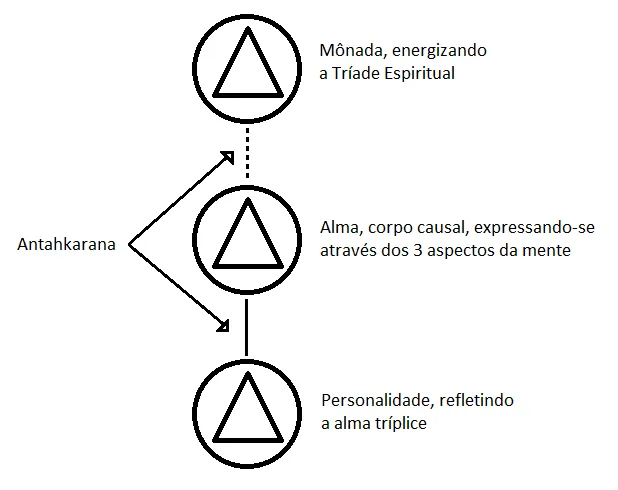
Even though the sutratma is always active, the threads of consciousness and creativity must be consciously constructed and reinforced. This is where the disciple’s effort begins.
A second image shows even more clearly the position of the Spiritual Triad, the causal body, and the mental unit within the mental plane:

Note that the causal body is only one subplane above the mental unit. It is not located on a different plane, but on the same mental plane where we already have some level of activity. This means the first step on the higher journey — contact with the soul — is symbolically within reach.
Becoming the Path
In The Rays and the Initiations, Djwhal Khul writes:
“The mental plane which has to be bridged is like a great stream of consciousness or of conscious substance, and across this stream the antahkarana must be constructed. This is the concept which lies behind this teaching and behind the symbolism of the Path. Before a man can tread the Path, he himself must become that Path. It is of the substance of his own life that he must weave this rainbow bridge, this illumined Way. He weaves it and anchors it as the spider weaves a thread along which it can travel.”
(p. 464)
The construction of the antahkarana is literally made of the substance of one’s own consciousness. DK insists that meditative work is the key to building this bridge — a view echoed throughout his teachings. Each thought, intention, and qualified visualization contributes to this process. The mind, when disciplined, becomes the thread that sews the worlds — from personality to soul, and from soul to Monad.
This work rests on two essential pillars:
- Creative meditation – as a building technique.
- Impersonal service – as a path for qualifying mental matter.
The Work on the Mental Plane
Both the lower and higher antahkarana must be built on the mental plane. This reinforces the mind’s central role in esoteric work — not just as intellect, but as spiritual matter and vehicle. It is on the mental plane that the soul begins to express itself clearly, and where the great spiritual decisions are made.
Our focus at this stage is to eliminate the “discontinuity” of consciousness between the lower mind and the soul (causal body). Achieving this, the aspirant “takes his stand, and looking upward, sees a promised land of beauty, love, and future vision.”
Alice Bailey outlines in The Rays and the Initiations the six stages of building the antahkarana:
- Intention – clear direction of the spiritual will.
- Visualization – creative use of concentrated imagination.
- Projection – thrust of mental energy toward the higher.
- Invocation and evocation – calling the soul and receiving its response.
- Stabilization – vibrational consolidation of the bridge.
- Resurrection – full entrance of consciousness into higher life.
Associated with the journey toward the third initiation — the unification of the three personality vehicles and their use as the soul’s expression — the conscious, persistent construction of this “bridge” in mental matter is essential.
A careful reading of pages 441 to 530 of the cited work is highly recommended for in-depth study.
Once functional, the bridge allows the disciple to become a conscious instrument of the spiritual will, acting as a servant of the plan and channel of monadic light.
The Crucifixion and the End of the Causal Body
The climax of the process occurs at the fourth initiation, called the “crucifixion” — a symbolic term indicating the sacrifice of the soul as intermediary.
When the antahkarana is fully constructed, the causal body — which had functioned as a protective “shell” for higher consciousness — is dissolved, since direct connection with the Monad is now possible.
From that point on:
- The sutratma remains, now fully qualified by consciousness.
- The being can focus attention on any plane at will, taking on forms and functions as needed.
Consciousness no longer depends on intermediate vehicles: it is monadically free.
A Personal and Collective Path
Although the antahkarana is built individually, it is not a private bridge. Each thread of light joins with others — from fellow disciples, aspirants, and servers.
Djwhal Khul affirms:
“The antahkarana is now being constructed by all soul-infused personalities (…) and it is rapidly becoming a strong cable, composed of all the many threads of living light, of consciousness and of life; these threads are so interwoven and blended that no one can truly say: ‘my thread, or my bridge, or my antahkarana.’”
— Discipleship in the New Age
This rainbow bridge is, therefore, the hidden structure of the new spiritual world — a living network uniting Monads and souls in group consciousness.
Every human being who builds their antahkarana contributes a color, a vibration, a tone that integrates into the whole. The bridge is not merely a passage: it is also a collective body of light that uplifts humanity as a whole.
Conclusion
The antahkarana is far more than an esoteric theory. It is the Path under construction, the bridge we are called to become.
To walk this path is to unite soul and personality within, and later soul and spirit. It is to become a living channel for the Monad’s will, radiating light where once there was separation.
We build this bridge with mental discipline, persistent meditation, silent love, and selfless service. And in doing so, we open a path not only for ourselves, but for all.
“Continue with the work of building the antahkarana, and the light will shine upon your path, and revelation will accompany your steps.”
— Djwhal Khul
Recommended reading:
- The Rays and the Initiations (Alice Bailey), pp. 441–530
- Discipleship in the New Age, vol. II
- Related article: The Importance of the Group on the Spiritual Path
Support the Project
This site is independently maintained, with no institutional ties. If the content inspires you, consider supporting it through a small donation.