
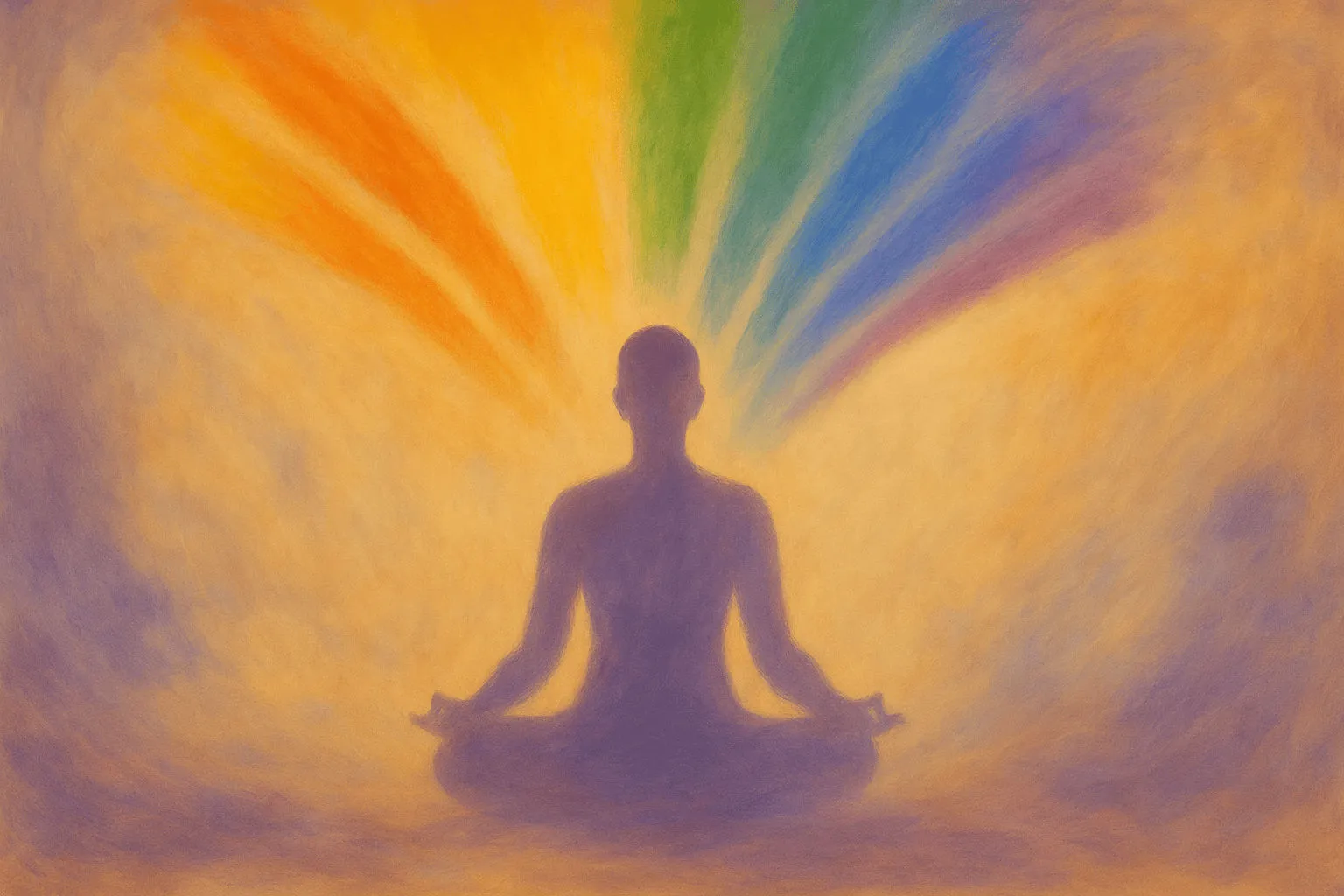
“The seven rays are the sum total of the qualities of the life of the one manifesting Life.”
— Alice A. Bailey, Esoteric Psychology I, p. 57
Series: Introduction to the Seven Rays
The term “Seven Rays” has become relatively common in esoteric circles, but its meaning is often obscured by the multiplicity — and sometimes contradiction — of the interpretations available. Conflicting color associations, differing definitions, and mixed systems make it difficult to understand what the Rays truly are and where they come from.
Within the teachings of Alice A. Bailey, the Seven Rays occupy a central position. They form the backbone of Esoteric Psychology, shaping her understanding of the soul’s evolution and the vibrational structure of all life forms. To understand the Rays is, in essence, to understand the language of the soul in action.
This article — and the others in this series — aim to present the foundations of this teaching through the lens of modern theosophy. The emphasis is on the writings of Djwal Khul, the Tibetan Master who dictated much of Bailey’s work, with complementary references to the tradition of H. P. Blavatsky where relevant.
What Are the Seven Rays?
At the beginning of Esoteric Psychology I, we find this foundational statement:
“There is One Life, which expresses Itself primarily through seven basic qualities or aspects, and secondarily through the myriad forms.”
— Esoteric Psychology I, p. 141
And later:
“A ray is but a name for a particular force or type of energy, with the emphasis upon the quality which that force exhibits and not upon the form aspect which it creates. This is the true definition of a ray.”
— Esoteric Psychology I, pp. 315–316
Blavatsky, in her own foundational text, writes:
“As there are seven Dhâtu (principal substances in the human body), so there are seven forces in man and in all Nature.”
— The Secret Doctrine I, p. 289 (Adyar edition)
These statements converge on a central idea: the Rays are fundamental qualities of divine consciousness in manifestation. They are not merely pedagogical categories, but living, dynamic, universal realities.
Just as white light divides into seven colors when passing through a prism, the One Life, when expressing itself in the manifested worlds, refracts into seven distinct qualities. These vibrations shape all that exists — from galaxies to human emotions — and operate across all planes of reality.
As Djwal Khul states:
“They are therefore the sum total of all souls within the solar system, and their activity produces all forms.”
— Esoteric Psychology I, p. 59
These energies pass through many levels before reaching us. In the human constitution, they are reflected in our bodies, emotions, thoughts, and even the very quality of the soul.
The Seven Rays in Blavatsky’s Cosmology
The origin of the Seven Rays can be traced back to the esoteric cosmology laid out by H. P. Blavatsky in The Secret Doctrine. Although she does not use the term “Seven Rays” with the same systematic definition later brought forth by Djwal Khul, Blavatsky presents the idea of seven fundamental forces that emanate from the Primordial Unity and organize manifestation.
“As there are three, so there are seven, and so there are countless forms in manifestation.”
— The Secret Doctrine I, p. 113 (paraphrased from Stanza III)
These seven forces are described as emanative and express themselves both as planes of existence and as principles of consciousness, present in both the cosmos and the human being. In several passages, Blavatsky connects the seven aspects to the work of the Dhyan-Chohans, the cosmic builders who together enact the will of the Logos.
“The primordial Seven, the first seven breaths of the Dragon of Wisdom, are the Rays of the Logos through whom the One Light manifests.”
— The Secret Doctrine (synthesized from multiple passages)
In Blavatsky’s view:
- The Seven Rays are intrinsic aspects of manifestation, inseparable from the structure of the cosmos.
- They are intelligent forces, not abstractions, linked to the action of spiritual Hierarchies.
- They operate simultaneously on planetary, human, and occult levels.
This approach — more veiled and symbolic than that of Bailey — serves as a metaphysical foundation for the doctrine of the Rays. Bailey’s contribution, through Djwal Khul, may be seen as a later systematization, suited to the current evolutionary cycle and the language of esoteric psychology.
Origin and Transmission of the Energies
According to Esoteric Psychology I (p. 85), the energy of the Rays originates in the stars of the Great Bear. From there, these forces are transmitted by seven great Beings — the Seven Logoi — who then radiate the energies through the sacred planets (Mercury, Venus, Jupiter, Saturn, Uranus, Neptune, and Vulcan, which remains undiscovered) and the zodiacal constellations, eventually reaching our solar system in a descending chain of consciousness.
Each stage of this transmission functions as a vibrational transformer. One might compare it to a hydroelectric plant: water powers a turbine to generate electricity, but that electricity must pass through transformers before being usable in a household. Plugging a device directly into the raw current would destroy it. The energy is the same in essence, but must be modulated in voltage and intensity to be safely received.
Likewise, the cosmic energies of the Rays are gradually appropriated, transformed, and specialized before reaching the dense planes of human experience. Each “tonality” influences a distinct aspect of consciousness and matter.
In this way, our thoughts, emotions, and behaviors can ultimately be understood as expressions of these great flows of spiritual energy.
Keywords and Symbolic Colors
As a first approximation, each Ray is commonly associated with a symbolic color and a key idea. These colors are not literal and vary across different traditions.
Alice Bailey notes an important distinction between esoteric and exoteric colors. The color perceived externally — via cultural associations or visual imagery — may not reflect the Ray’s true inner frequency. According to her, these colors convey vibrational qualities that can only be truly perceived by a trained spiritual intuition. Therefore, the following color associations should be seen as indicators, not absolutes.
Here is a comparative table of the more common exoteric colors and the esoteric colors described by Alice Bailey in *Esoteric Psycology I*:
Ray | Primary Quality | Exoteric Color | Esoteric Color |
|---|---|---|---|
1st | Will and Power | Red | Deep blue (or dark indigo) |
2nd | Love and Wisdom | Blue | Golden yellow |
3rd | Active Intelligence | Green | Pale rose (or soft violet) |
4th | Harmony through Conflict | Yellow | Emerald green |
5th | Concrete Knowledge or Science | Orange | Sapphire blue |
6th | Devotion and Idealism | Indigo | Ruby red |
7th | Ceremonial Order or Magic | Violet | Violet with lavender or amethyst hue |
These associations are useful as a starting point, but they do not exhaust the vibrational richness of each Ray. A deeper study of each will reveal psychological, ethical, vocational, and spiritual implications unique to its current of energy.
Knowing the color associated with a Ray — whether esoteric or symbolic — is not about visualization or rigid categorization. Its true value lies in recognizing vibrational patterns and developing energetic sensitivity. In meditation or intuitive service, these colors can act as keys of attunement, aligning our consciousness with a specific spiritual quality. More than a visual code, each color is a frequency: a field of divine expression that can be intuited and cultivated from within.
The Rays and Esoteric Psychology
Esoteric psychology, as presented by Alice Bailey, proposes a view of the soul as a dynamic center of qualified energy, whose expression in the world of form is shaped by a specific combination of Ray influences. These Rays affect how we think, feel, act, serve, and evolve.
This system operates on three primary levels:
- The Soul Ray, which expresses the higher spiritual purpose and the essential quality the soul seeks to radiate into the world.
- The Personality Ray, which shapes how we function in daily life — our talents, limitations, leadership style, communication, and drives.
- The Rays of the Mental, Emotional, and Physical Bodies, which influence the structure and tendencies of thought, feeling, and bodily energy.
Unlike conventional psychology — focused on behavioral patterns, family structures, or trauma — the esoteric approach is oriented toward archetypal qualities of energy. Each human being is seen as a unique expression of the One Life, colored by a distinct vibrational pattern.
Identifying one’s Rays requires long-term self-observation, intuitive discernment, and a life directed toward service. However, even at early stages, subtle signs may be noticed: one’s dominant spiritual motivation (such as wisdom, will, devotion, or harmony), types of work one is drawn to, recurring life themes, or patterns of inner growth and challenge.
For example, a soul on the Second Ray (loving wisdom) may be incarnated in a First Ray personality (directive will), creating tension between sensitivity and assertiveness. Over time, the path of integration seeks to align these forces around a common spiritual intent — the soul’s full expression through the personality.
The language of the Rays is not fixed in labels, but expressed in subtle vibrational tendencies that become clearer as we cultivate alignment between soul and personality. Esoteric Psychology is not a diagnostic system, but a key to inner understanding — a way of recognizing who we are through the energy we are here to express and the path our soul has chosen to follow.
Alternative Perspectives and Considerations
Over the decades, the Seven Rays have been reinterpreted by various spiritual movements, such as The Bridge to Freedom, The Summit Lighthouse, and other devotional or New Age schools. In those contexts, the Rays are often linked to fixed colors, days of the week, Chohans, Archangels, and etheric temples — forming systems of decrees and invocations.
While these approaches have inspired many sincere seekers, they should be seen as secondary systems, derived from the original theosophical teachings but containing significant reinterpretations. Often, they emphasize devotional or hierarchical aspects, at times simplifying the deeper philosophical and cosmological foundations presented by Blavatsky and Bailey.
This series will aim to preserve the clarity and metaphysical depth of the theosophical tradition, respecting its symbolic structure and avoiding terminological confusion that arises from mixing divergent frameworks. Discernment, one of the most valued qualities in esoteric teachings, will be our guide.
Conclusion
The study of the Seven Rays offers a key to understanding the living forces that shape both individual and collective consciousness. More than a theoretical structure, it is a spiritual language in which the soul recognizes its own colors, challenges, and potential.
As we come into contact with these seven universal qualities, we begin to realize that our path is not random — it follows a specific vibrational rhythm, an energy signature that guides, inspires, and invites us to integrate soul and form.
The true inquiry into the Rays is not undertaken with intellect alone, but through inner attention, conscious living, and sincere commitment to self-knowledge and service. Each insight, then, becomes not just an idea, but a step toward the spiritual purpose that animates our being.
Key References
- Alice A. Bailey – Esoteric Psychology I & II, A Treatise on Cosmic Fire
- H. P. Blavatsky – The Secret Doctrine
Series: Introduction to the Seven Rays
Support the Project
This site is independently maintained, with no institutional ties. If the content inspires you, consider supporting it through a small donation.