

“That which many think about intensely takes on a life of its own in the invisible world.”
— Esoteric tradition
Series: Paths of Spiritual Development
Egregore is a word frequently used — and often inappropriately. It is a misunderstood concept, which allows egregores to influence us without our awareness. Not knowing about this influence, or not believing in it, makes no difference — just as not believing in gravity doesn’t prevent you from falling.
An egregore is an energetic field generated by the sum of the intentions, thoughts, and emotions of a group. How these forces operate, and how we can consciously align ourselves with them, is what this text explores.
Energetic flows and the importance of attunement
We know there are various energy flows that course through our body. There are hundreds of books about the chakras — I particularly recommend the work The Chakras by C. W. Leadbeater, available here on the site. Knowing at least a little about these energetic centers and the channels that connect our subtle system facilitates the maintenance of inner balance — the foundation for a more harmonious and productive life.
But we live immersed in many other flows of forces — hundreds of mental, astral, and spiritual thought-forms. We receive the energetic impact of practically all forms of life that surround us. These external flows interact with the internal ones, in synergy or opposition, largely determining the general conditions of our existence. Knowing our own centers and internal flows is not enough. The external flows and their influences also deserve investigation, so that we can use them to our advantage, just as we do with our individual energy.
What is an egregore?
The word egregore comes from the Greek egregoros, which means “watcher,” derived from egeiro, “to observe.” We find references to the term in the Bible, such as in Daniel 4:13: “I saw in the visions of my head upon my bed, and, behold, a watcher and an holy one came down from heaven.” The word translated as “watcher” is, in the original, egregoros.
Various religious and esoteric traditions recognize mental, astral, or spiritual constructions that act as collective entities — although they don’t always use the term egregore. The tradition of ceremonial magic, for example, recognizes complex thought-forms that can be animated by ritualistic intention.
Here, egregore designates a mental, astral, or spiritual construction sustained by a group over time. This prolonged and constant sustenance makes it relatively stable, even if the original individuals are no longer involved. Therefore, some egregores span millennia, potentially strengthening with each generation that connects to them.
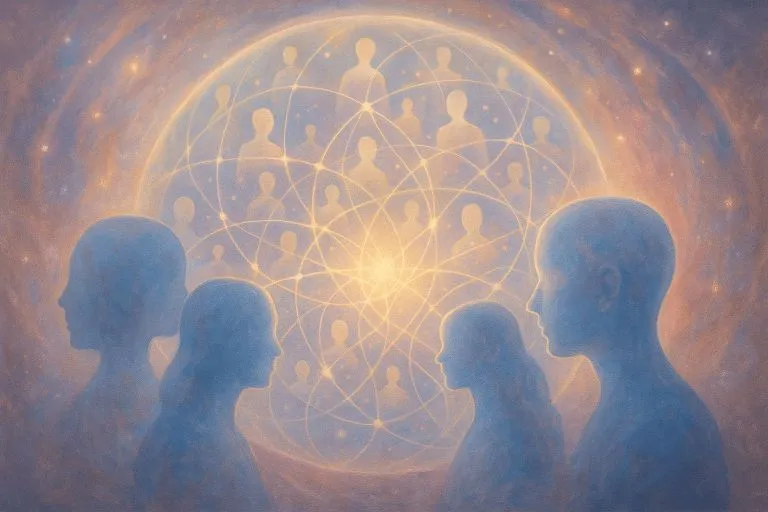
Egregores are not “mystical things” in the pejorative sense. There is a Catholic egregore, a Jewish one, one of Umbanda. But there is also one of Coca-Cola, Adidas, and your university. We live in contact with hundreds of them — perhaps thousands.
How does an egregore form?
An egregore forms when similar thoughts, feelings, and intentions begin to mutually reinforce each other, creating a collective field. For example: when we read a work by Blavatsky, we generate thought-forms associated with her teachings. Other readers do the same. Over time, these forms group together and stabilize into a cohesive field, with which we attune whenever we turn to Blavatsky’s figure or work.
We are not entering into contact with Blavatsky’s soul itself, but with the egregore collectively built around her legacy. This field can inspire us with ideas we didn’t consciously create, but which are part of the vibrational reservoir of this collective construction.
These egregores normally are not limited to a single plane. They are composed of matter from the astral, mental, and spiritual planes, simultaneously awakening thoughts, feelings, and intuitions in those who connect to them.
Environments, resonance, and discomfort
When we enter an environment and feel uncomfortable, what often happens is a clash between the vibration of the local egregore and our own energy. Places like churches, spiritual centers, libraries, or football stadiums possess potent egregores that influence our inner state.
Certain environments seem to “favor” particular activities precisely because of this. Want to study? A library is more effective than a bar. Want to feel religious fervor? A cathedral is a more potent field than your bedroom. All of this is vibrational resonance.
Everyday examples
Consider a company environment. Each organization develops its own culture — values, attitudes, and behavior patterns that mutually reinforce each other. Over time, this culture forms a true egregore: a subtle presence that influences the emotional state, productivity, and even the decisions of employees.
When a new person enters this field, they often spontaneously adjust their attitude to align with the collective vibration — whether it is harmonious or toxic.
The same applies to online communities. Have you noticed how certain groups seem to drain your energy, while others leave you inspired? A group where sarcasm, criticism, or alarmism predominate creates a corresponding vibrational field, affecting its members emotionally even outside the digital environment.
Similarly, groups focused on sincere sharing, meditation, or spiritual study build egregores that elevate and inspire.
The conscious choice of which spaces to frequent — including online — directs our energy with responsibility.

How resonance shapes consciousness
Our subtle bodies vibrate at specific frequencies, determined by our thoughts, emotions, and spiritual state. These vibrations enter into resonance with egregores of harmonic frequencies — and, as we harmonize with them, both our vibration and that of the egregore gain intensity.
We strengthen egregores merely by our attunement to them. This explains the partial effectiveness of techniques like those in The Secret: by harmonizing with an idea, you become influenced by the collective forces associated with that idea. However, these forces do not replace action, effort, or karma. Desiring a car doesn’t make it materialize.
What kind of circuit are you feeding?
Resonance can also imprison us. Recurrent negative emotions connect us to destructive egregores, and this connection reinforces them while intensifying our negativity. A vicious cycle emerges: we are stimulated to repeat mental and emotional patterns that drain our vitality.
This is not about entities with their own will — although, in some cases, thought-forms can be animated by external consciousnesses — but rather vibrational fields that tend to preserve and grow themselves. If we are vibrationally compatible, we are attracted and influenced by them.
Sometimes we break these cycles by chance, when something diverts our attention. But knowing how these mechanisms work is what allows us to interrupt them (or strengthen them) consciously.
The power of attention and presence
Our focus determines our attunement — what we give attention to is what we receive. Those who seek mental clarity should not cling to frequencies of drama and negativity.
These available frequencies are a facet of the collective unconscious: an infinite source of knowledge, but also a sea of distractions. We live constantly switching attunement — working while thinking about personal life, studying with our minds on vacation, conversing while mentally making lists.
Zen Buddhism offers an antidote: presence in the present. When brushing your teeth, pay attention to the movement and sensation. When eating, feel the taste, texture, smell. When listening to someone, truly listen.
Each activity has specific egregores that can be accessed when we give it full attention. The synergy between internal and external flows then establishes itself, and the result is spiritual potency in daily life.
The trap of unwanted attention
Direct opposition to an egregore, paradoxically, reinforces its presence. Focusing on something to reject it is, in practice, connecting it to you. Instead of fighting against it, redirect your attention to what you wish to cultivate. The best way to neutralize an unwanted vibration is to feed a higher one.
Daily rituals — such as giving thanks before meals, or moments of silence before an important activity — help us attune to higher fields. Small conscious gestures shape great internal transformations.
Simple as that, although not necessarily quick. The important thing is to persist and use our will consciously, with direction.
Will as creative force
Our will, expressed with constancy through our thoughts and actions, determines with which egregores we connect. Will is the key. And when aligned with elevated purposes, it gives us access to forces accumulated by generations.
In this sense, “all that we ask shall be given to us” is true — as long as we know what we are asking for and have the energy and focus to sustain that will. Maintaining this focus is one of the greatest challenges of spiritual life — and also its essence: learning to direct consciousness and, with it, destiny.

Conclusion
Being in tune with an egregore is being immersed in a field of intention — whether conscious or unconscious. It is up to each person to discern what they are collaborating with: we reinforce that which we think about together.
With presence, discernment, and will, we can choose the fields we wish to nourish — and be a living part of their expression in the world.
By recognizing the egregores we feed, we become more conscious of the realities we co-create.
Series: Paths of Spiritual Development
Support the Project
This site is independently maintained, with no institutional ties. If the content inspires you, consider supporting it through a small donation.